Anti-corrosion Thermal Resistance
Product Overview
Section titled “Product Overview”Anti-corrosion thermal resistance is mainly applied in strongly corrosive and low-temperature locations. Its casing is wrapped with PTFE, PFA, P46, and other PTFE materials. The anti-corrosion process is suitable for most acid, alkali, and organic corrosion conditions. The operating temperature is below 200 °C. It can replace high-nickel alloy, titanium, tantalum, and other materials, offering good cost performance.
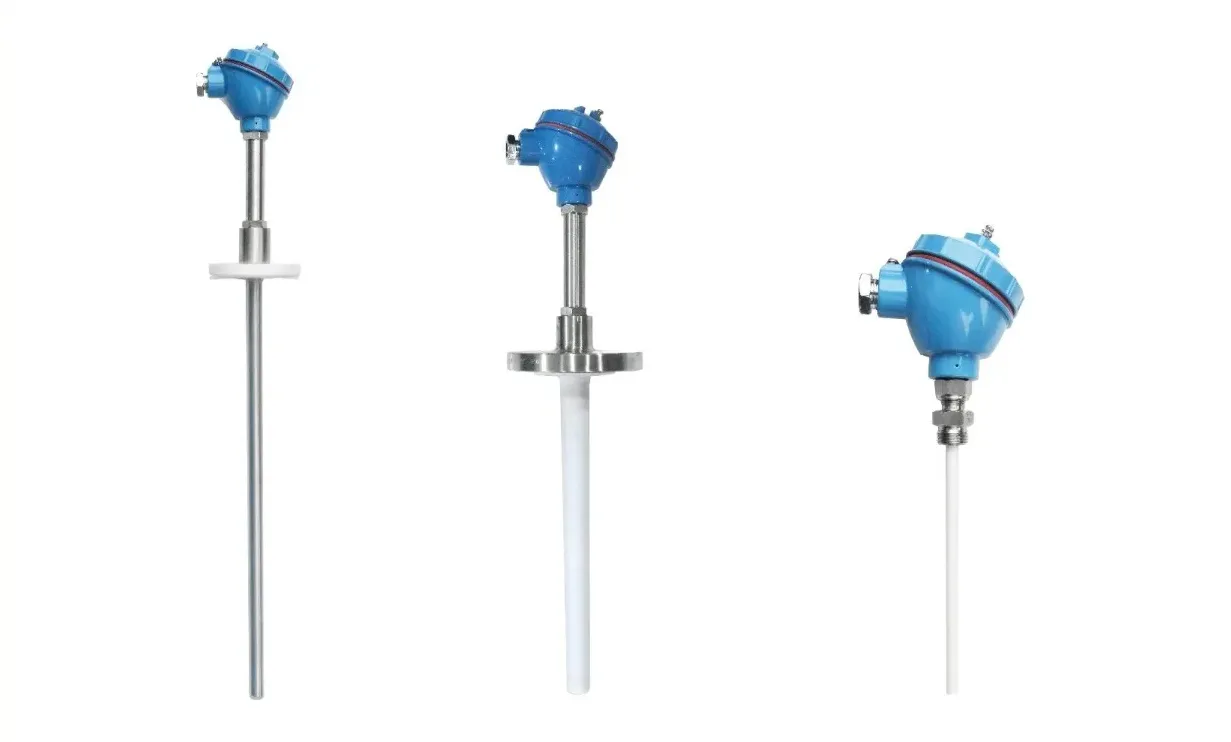
The corrosion-resistant coating process includes bushing and sintering processes.
Applications
Section titled “Applications”- Temperature measurement in strongly corrosive and low-temperature locations.
- Conditions involving most acid, alkali, and organic corrosive media.
- Temperature measurement applications with an operating temperature below 200 °C.
Product Advantages
Section titled “Product Advantages”- The casing is wrapped with PTFE, PFA, P46, and other PTFE materials for corrosive-medium conditions.
- The anti-corrosion coating can use a bushing process or a sintering process.
- It can replace high-nickel alloy, titanium, tantalum, and other materials.
- Tetrafluoro thickness is not less than 1.5 mm.
Installation Method
Section titled “Installation Method”The product images show flange-connection and threaded-connection structures. Please confirm the installation arrangement according to the site connection, insertion length, and casing structure.
Key Parameters
Section titled “Key Parameters”| Model | Graduation | Temperature Measurement Range | Tetrafluoro Thickness | Allowable Deviation |
|---|---|---|---|---|
| WZP-73F-TH02F | PT100 | -200 to 200 °C | ≥1.5 mm | Class A: ±(0.15 + 0.2%|t|); Class B: ±(0.30 + 0.5%|t|) |
Optional Configurations
Section titled “Optional Configurations”- Coating materials: PTFE, PFA, P46, and other PTFE materials.
- Anti-corrosion coating processes: bushing process or sintering process.
Main Models
Section titled “Main Models”- WZP-73F-TH02F
Please Provide the Following for Inquiry
Section titled “Please Provide the Following for Inquiry”- Measured medium and its acid, alkali, or organic corrosion conditions.
- Actual operating temperature, to confirm whether it is below 200 °C.
- Required graduation, temperature measurement range, and allowable deviation class.
- Required coating material and anti-corrosion coating process.
- Installation connection, site connection dimensions, and required insertion length.