Flexible Multi-point Thermocouple
Product Overview
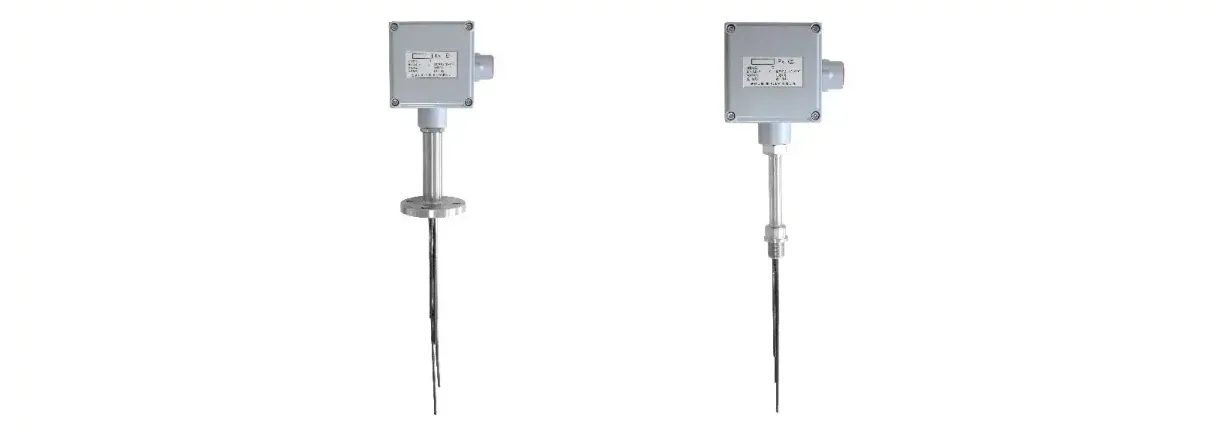
Section titled “Product Overview”The flexible multi-point thermocouple is suitable for production sites with an insignificant temperature gradient where temperatures at multiple positions or multiple points at one position must be measured simultaneously. It is widely used in large fertilizer synthesis towers, storage tanks, and similar equipment.
Applications
Section titled “Applications”- Production sites requiring simultaneous temperature measurement at multiple positions or multiple points at one position.
- Large fertilizer synthesis towers.
- Storage tanks and similar equipment.
Product Advantages
Section titled “Product Advantages”- Meets simultaneous temperature-measurement requirements for multiple measurement points.
- Thermal response time: no more than 8 s.
- Element diameter options: Φ1, Φ2, Φ3, Φ4, Φ5, Φ6, or Φ8.
- Protection grade: IP65.
Installation Method
Section titled “Installation Method”Two installation and fixation forms are available: fixed thread and fixed flange. The multi-point structure diagrams use different lengths, such as T1, T2, T3, T4, and T5, to identify measurement-point locations. Provide the installation length and location of each measurement point for selection.
Key Parameters
Section titled “Key Parameters”Product Parameters
Section titled “Product Parameters”| Parameter | Value |
|---|---|
| Electrical interface | M20×1.5; NPT1/2 |
| Thermal response time | ≤8 s |
| Element diameter | Φ1; Φ2; Φ3; Φ4; Φ5; Φ6; Φ8 |
| Protection grade | IP65 |
Models and Temperature Measurement Ranges
Section titled “Models and Temperature Measurement Ranges”| Model | Graduation | Temperature Measurement Range | Installation and Fixation Form |
|---|---|---|---|
| WRNK-240D | K | 0 to 1000 °C; 0 to 800 °C | Fixed thread |
| WRE-240D | E | 0 to 800 °C | Fixed thread |
| WRN-240D | K | 0 to 1000 °C; 0 to 800 °C | Fixed flange |
| WRE-440D | E | 0 to 800 °C | Fixed flange |
Optional Configurations
Section titled “Optional Configurations”- Installation and fixation form: fixed thread or fixed flange.
- The structure diagrams show a multi-layer armored multi-point thermocouple, single point leakage isolation structure, and pressure gauge with alarm structure.
Main Models
Section titled “Main Models”- WRNK-240D
- WRE-240D
- WRN-240D
- WRE-440D
Please Provide the Following for Inquiry
Section titled “Please Provide the Following for Inquiry”- Equipment, measured medium, and actual temperature range at each measurement point.
- Required number of measurement points, and the installation location and length of each point, such as T1, T2, T3, T4, and T5.
- Required graduation, element diameter, and response-time requirement.
- Installation and fixation form, fixed thread or fixed flange, together with connection specifications.
- Whether a multi-layer armored multi-point structure, single point leakage isolation structure, or pressure gauge with alarm structure is required.
- Required protection grade, electrical interface, and site environment.
Related Accessories
Section titled “Related Accessories”- Pressure gauge with alarm: shown in the structure diagram.