Explosion-proof Bimetal Thermometer
Product Overview
Section titled “Product Overview”The explosion-proof bimetal thermometer uses an electrical contact structure. It directly measures the temperatures of liquid, steam and gas media in production processes, with a measurement range of -80 to +500°C. Temperature change causes the electrical contact to connect with or disconnect from the upper and lower limit contacts, operating the relay in the circuit for automatic control and alarm.
Applications
Section titled “Applications”- Temperature measurement of liquid, steam and gas media in production processes.
- Applications requiring local temperature indication, automatic control and alarm.
- Temperature-measurement applications requiring the Ex db IIC T4…T6 Gb explosion-proof grade.
Product Advantages
Section titled “Product Advantages”- Local temperature indication for direct reading.
- Automatic power cut-off and alarm function.
- Thermal response time not more than 40 s.
- Protection level available in IP55, IP65 and IP66.
- Explosion-proof grade: Ex db IIC T4…T6 Gb.
Installation Method
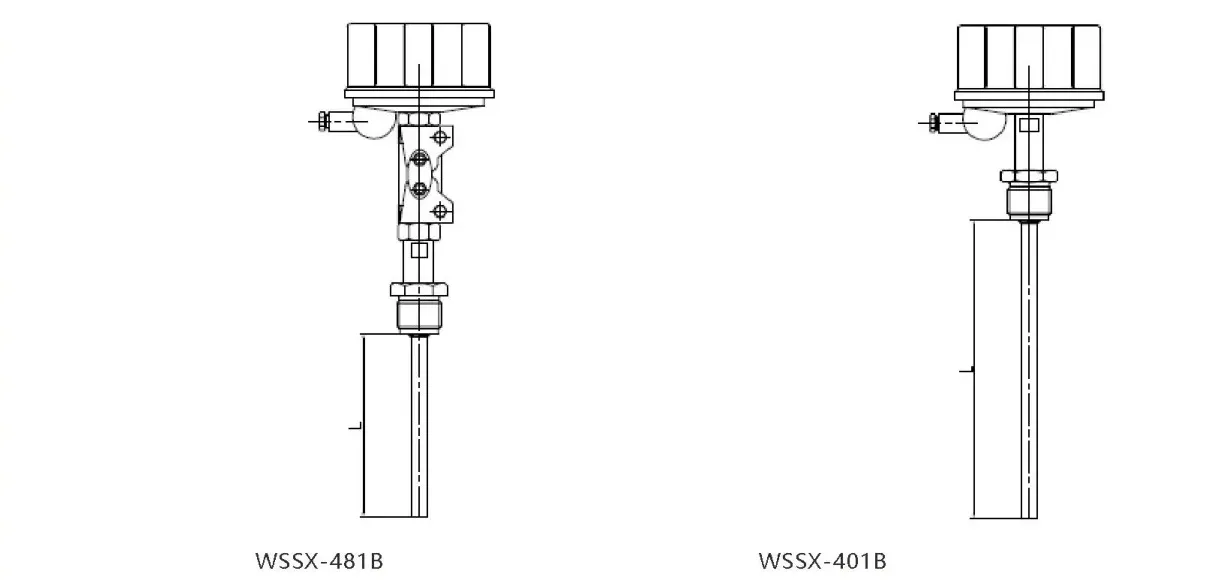
Section titled “Installation Method”The structure diagram shows two constructions: WSSX-481B and WSSX-401B. For selection, provide the required insertion length L, mounting connection and available installation space.
Key Parameters
Section titled “Key Parameters”| Item | Parameter |
|---|---|
| Applicable standards | JB/T8803, GB/T3836 |
| Nominal dial diameter | 60, 100, 150 mm |
| Accuracy class | Class 1.0, Class 1.5 |
| Thermal response time | ≤40 s |
| Protection level | IP55, IP65, IP66 |
| Explosion-proof grade | Ex db IIC T4…T6 Gb |
| Rated power | 10 VA |
| Maximum working voltage | 220 V, 24 V |
| Maximum allowable current | 0.7 A |
| Normal atmospheric operating conditions | Temperature -25 to +55°C; relative humidity ≤85% |
| Set-point error | Not more than 1.5 times the switching difference of the basic error limit; switching difference not more than 1.5 times the basic error limit |
| Switching repeatability | Not greater than 1/2 of the absolute value of the basic error limit |
Insulation Resistance
Section titled “Insulation Resistance”| Rated voltage | DC test voltage | Insulation resistance |
|---|---|---|
| 7 V | 24 d.c | 100 |
| 20 V | 220 a.c | 500 |
Main Models
Section titled “Main Models”- WSSX-481B
- WSSX-401B
Information Required for Inquiry
Section titled “Information Required for Inquiry”- Required temperature measurement range, accuracy class and dial diameter.
- Installation position, insertion length L, mounting connection and protective-tube specification.
- Required explosion-proof grade and site-area requirement.
- Required set point, control or alarm method, and working voltage.
- Measured medium, operating temperature, pressure and required quantity.