Wear-resistant Thermocouple (Thermal Resistor)
Product Overview
Section titled “Product Overview”The wear-resistant thermocouple (thermal resistor) consists of a wear-resistant protection tube, temperature sensing element, mounting device, junction box, and other components. It is used for temperature measurement of flowing media and can be applied in coal mills and circulating fluidized beds in power plants, catalytic cracking units in the chemical industry, kiln heads and kiln tails in cement plants, and incinerators.
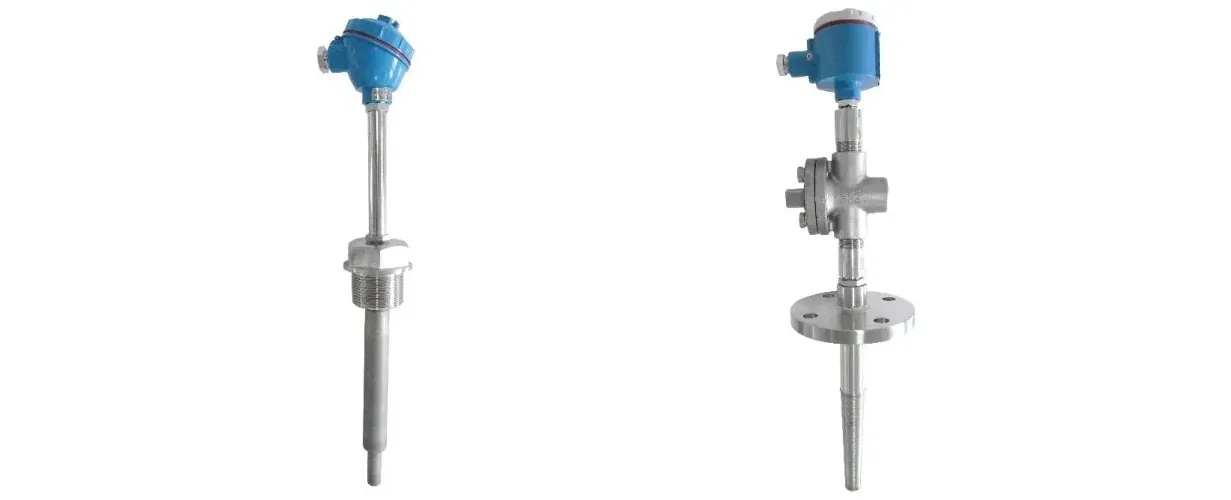
For a cut-off wear-resistant thermocouple, the cut-off valve supplied with the product can be closed promptly when protection-tube wear and leakage occur, preventing continued leakage. For measurement points with particularly high leakage-prevention requirements, a ferrule-type anti-internal-leak wear-resistant thermocouple may be used. Its fixed ferrule threaded connection provides good sealing performance to help prevent leakage of the measured medium.
Applications
Section titled “Applications”- Temperature measurement in coal mills, circulating fluidized beds, flue gas, coal ash, and other power-plant conditions.
- Catalytic cracking units, coal liquefaction reactors, and hydrogenation reactors in the chemical industry.
- Cement plant kiln heads and kiln tails exposed to high-temperature gas flow and particle scouring.
- Temperature measurement of flowing media in boilers, paper mills, and incinerators.
Product Advantages
Section titled “Product Advantages”- The spray wear-resistant type uses a laser spray process to apply hard alloy to the protection tube and has a maximum operating temperature of 800 °C.
- The surfacing wear-resistant type uses a laser surfacing process to form a cobalt-based alloy or nickel-based alloy layer on the metal protection-tube base.
- The integral casting wear-resistant type is suitable for high-temperature gas flow and particle scouring, abrasion, and corrosion in cement kilns and circulating fluidized beds, with good thermal stability and high-temperature strength.
- Cut-off and ferrule-type anti-internal-leak structures are available for leakage-prevention requirements.
Installation Method
Section titled “Installation Method”The structure diagrams show flange connections, threaded connections, and fixed ferrule threaded connections. For measurement points with particularly high leakage-prevention requirements, a ferrule-type anti-internal-leak wear-resistant thermocouple may be used. For a cut-off wear-resistant thermocouple, the cut-off valve supplied with the product can be closed when protection-tube wear and leakage occur.
Key Parameters
Section titled “Key Parameters”Wear-resistant Category and Material Selection
Section titled “Wear-resistant Category and Material Selection”| Wear-resistant Category | Material | Operating Temperature | Service Place |
|---|---|---|---|
| Spray wear-resistant | Ni60 coating; WC coating | 800 °C | Power plant flue gas, coal ash, boilers, paper mills, etc. |
| Integral casting wear-resistant | Iron-based alloy; nickel-based alloy; cobalt-based alloy | 1200 °C | Power plant circulating fluidized bed boilers, boiling furnaces, coal mills, cement plant kiln heads, kiln tails, etc. |
| Surfacing wear-resistant | Stearic alloy | 1100 °C | Chemical industry catalytic cracking devices, coal liquefaction reactors, hydrogenation reactors, etc. |
Optional Configurations
Section titled “Optional Configurations”- Spray wear-resistant: Ni60 coating or WC coating.
- Integral casting wear-resistant: iron-based alloy, nickel-based alloy, or cobalt-based alloy.
- Surfacing wear-resistant: Stearic alloy.
- Leakage-prevention structures: cut-off wear-resistant thermocouple or ferrule-type anti-internal-leak wear-resistant thermocouple.
Main Models
Section titled “Main Models”- WRN-440NQ (cut-off valve)
- WRN-440 (with leakage prevention)
- WRN-240NM
Please Provide the Following for Inquiry
Section titled “Please Provide the Following for Inquiry”- Equipment, measurement location, and measured medium.
- Particle conditions in the medium and the gas-flow or medium-flow conditions.
- Actual operating temperature and the required wear-resistant category or material.
- Installation connection, such as flange, thread, or fixed ferrule threaded connection.
- Whether a cut-off valve or anti-internal-leak structure is required.
- Required insertion length, connection dimensions, and preferred model.